Guided Reading Strips & Dyslexia Colored Overlays: How Visual Tracking Tools Stop Line-Skipping
Discover how guided reading strips and tinted color overlays stop line-skipping, ease visual stress, and improve reading tracking for dyslexia and ADHD.
What Are Guided Reading Strips and Colored Overlays?
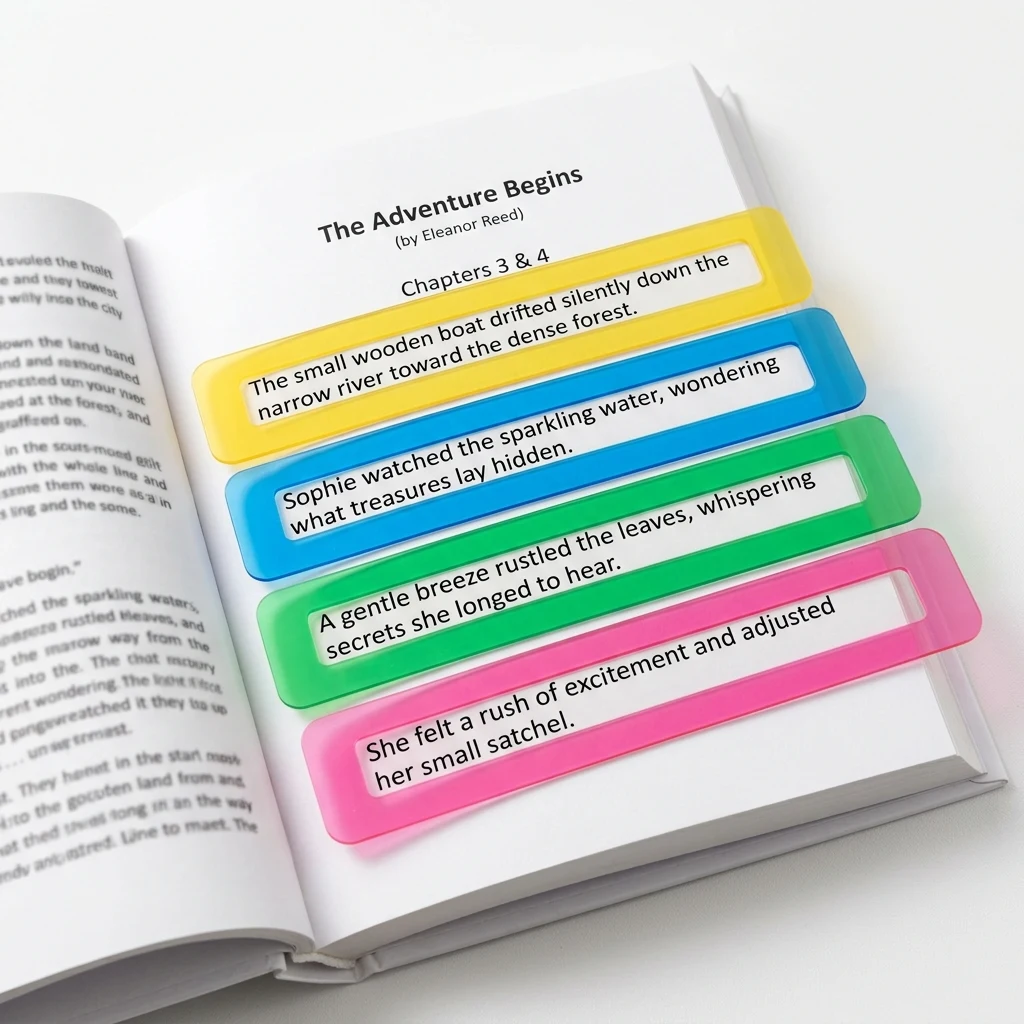
Direct Answer: Guided reading strips (also called reading rulers, line trackers, or tinted highlight overlays) are flexible, optically transparent plastic rulers featuring a narrow colored highlight window bordered by opaque or semi-opaque tracking bars that isolate a single line of printed text while keeping the surrounding paragraph visible for contextual flow.
For millions of children and adults with dyslexia, ADHD, or Meares-Irlen syndrome (Visual Stress), reading black text on brilliant white paper creates intense ocular discomfort. Letters often appear to vibrate, blur, halo, or drift across the page. This neurological sensory sensitivity leads to constant line-skipping, word reversal, optical headaches, and severe cognitive fatigue.
Guided reading strips like the Dyslexia Guided Reading Strips provide an immediate, zero-battery physical accommodation. By physically framing one line at a time through an optimal color filter, they calm retinal over-excitation and guide saccadic eye movements in a steady, unbroken linear progression.
The Science of Visual Stress (Meares-Irlen Syndrome) & Color Spectrum Filtration
Key Takeaway: Up to 45% of individuals with dyslexia and 20% of the general reading population experience Visual Stress (scotopic sensitivity), where high-contrast black text vibrating against bright white paper causes ocular hyperactivity that specific color wavelengths can neutralize.
Different visual cortex pathways respond uniquely to specific spectral wavelengths. An 8-pack of multi-colored reading strips allows readers to identify their unique optimal tint:
Yellow Overlays: Highly effective in lower lighting; enhances letter contrast and edge definition for readers who struggle with dim classroom illumination or faint paperback fonts.
Blue & Aqua Overlays: Absorbs high-energy blue-violet glare from harsh LED and fluorescent office ceiling fixtures, calming visual letter movement and shimmering sensations.
Green Overlays: Frequently preferred by adults reviewing dense spreadsheets, legal contracts, or technical textbooks because green reduces ocular strain and retinal bleaching during multi-hour sessions.
Pink & Magenta Overlays: Softens stark contrast for readers sensitive to bright white glossy paper stocks commonly found in modern university textbooks and school workbooks.
How Line Isolation Stops Word Crowding and Line-Jumping
Cognitive Mechanism: Visual crowding—the interference that neighboring text lines exert on peripheral word decoding—is a primary neurological bottleneck in developmental dyslexia and ADHD reading fatigue.
When an unassisted reader attempts to decode a paragraph, their peripheral vision constantly registers words directly above and below the target line. For neurodivergent readers, this input creates visual clutter that causes saccadic eye misdirection, leading the eye to jump up or down into adjacent sentences.
Guided reading strips solve visual crowding through dual-zone design:
1. The Transparent Highlight Zone: Illuminates the target sentence in the reader's chosen soothing color tint.
2. The Shaded Tracking Borders: Subdues the preceding and subsequent lines just enough to eliminate peripheral visual competition without disorienting the reader's spatial page awareness.
Low-Tech Reading Rulers vs. Full-Page Sheets vs. Optical TTS Pens
Comparing physical tracking aids and electronic reading tools across educational and functional criteria:
| Assistance Tool | Core Mechanism | Visual Stress Relief | Audio / TTS Decoding | Exam & IEP Approval |
|---|---|---|---|---|
| Guided Reading Strips | Single-line tinted plastic ruler | High (Specific color filtering) | No (Manual visual reading) | 100% Approved (Zero memory/tech) |
| Full-Page Colored Overlays | Full A4/Letter tinted acetate sheet | High across entire page | No (Manual visual reading) | 100% Approved across all exams |
| Standalone Reading Pen (Scanmarker PAL) | Optical scan head + Text-to-Speech | Bimodal audio eliminates decoding | Yes (Real-time synthetic voice) | Approved on non-dictionary testing |
| Digital Bimodal Software (Speechify) | Screen-based highlighting + TTS | Moderate (Screen blue-light trade-off) | Yes (Synthesized digital voice) | Restricted on locked exam devices |
Classroom Accommodations, Testing Regulations, and Synergistic Tool Pairing
Testing Advantage: Because guided reading strips contain zero electronic components, cameras, or digital memory, they are universally permitted under 504 Plans, IEP accommodations, GCSE, SAT, ACT, and workplace professional licensing exams with zero testing board waivers required.
Furthermore, guided reading strips pair seamlessly with electronic reading pens. Beginners using a scanning wand like the Scanmarker PAL or C-Pen Reader 2 often struggle with keeping the pen wand moving in a straight horizontal line across curved book pages. Resting a plastic reading strip directly underneath the printed line provides a physical straight-edge guide that prevents pen scanner drift.
How to Determine Your Child's or Student's Optimal Overlay Color
Follow this simple 4-step home or classroom assessment protocol to discover the most effective color overlay:
1. Select a Standard Reading Passage: Choose a dense, non-illustrated page from a grade-appropriate book.
2. Establish the Baseline: Have the reader read 2 paragraphs aloud without any overlay, noting reading speed, line skips, vocal hesitations, and blinking frequency.
3. Cycle Through the 8 Color Strips: Place each color strip (yellow, sky blue, dark blue, grass green, light green, pink, purple, orange) over the text for 30 seconds each.
4. Assess Spontaneous Preference: Ask the reader: 'Does this color make the words stop moving?' and 'Does this color feel soothing to your eyes?' In over 80% of visual stress cases, the student will immediately identify one or two colors that deliver instant clarity and visual relaxation.
FAQ
Do guided reading strips cure dyslexia?
No. Dyslexia is a neurobiological difference rooted in phonological processing in the brain, not an eye disorder. Guided reading strips do not cure dyslexia; however, they directly alleviate secondary Visual Stress (Meares-Irlen syndrome), eliminate visual crowding, and stop line-jumping, allowing readers to dedicate their cognitive energy to comprehension rather than struggling to keep their eyes on the line.
How do I know which color overlay is right for me or my child?
There is no single universal color for dyslexia. Every individual's visual cortex responds differently to light frequencies. The best approach is to test an assorted pack (including yellow, blue, green, and pink) against a page of dense black text. The correct color will immediately make the words feel stable, reduce eye-rubbing and blinking, and make reading visibly smoother.
Are colored reading strips permitted during official standardized school exams?
Yes. Unlike digital pens or calculators that may require special testing accommodation forms, physical colored reading strips contain no electronics, memory, or communication features. They are classified as standard passive visual aids and are universally permitted across state tests, SAT, ACT, and UK GCSE exams.
Can adults use guided reading strips in a professional office setting?
Absolutely. Many accountants, paralegals, data analysts, and executive researchers keep guided reading rulers on their desks to review dense spreadsheets, audit long financial ledgers, and proofread contracts without ocular fatigue under harsh office fluorescent lighting.
How do guided reading strips compare to text-to-speech reader pens?
Guided reading strips are passive, budget-friendly ($11) visual tracking rulers that improve line focus for readers who can decode words visually. Text-to-speech reading pens ($179–$299) are active digital devices with optical sensors and built-in speakers that read text aloud for readers who struggle with phonetic decoding.
How should plastic guided reading strips be cleaned and stored?
Clean transparent reading strips using a soft microfiber optical cloth lightly dampened with water or eyeglasses lens cleaner. Avoid harsh solvents, acetone, or abrasive paper towels that can scratch the smooth optical surface or remove the anti-glare finish.
Related guides
Reading Dense & Difficult Text Without Fatigue
Understanding & Overcoming Reading Fatigue
Important: Information in this guide is provided for general purposes and is not a substitute for professional medical, vision, or accessibility advice. A reading pen is an assistive tool that provides access to printed text — it does not diagnose, treat, or correct any reading, vision, or attention-related condition. Last reviewed: August 2026.
← All 37 guides