Reader Pen: How It Works and Who Actually Needs One
A reader pen scans a line of printed text and reads it aloud instantly — no phone, no app, no photo to take first. Here’s how it works and who actually uses one.
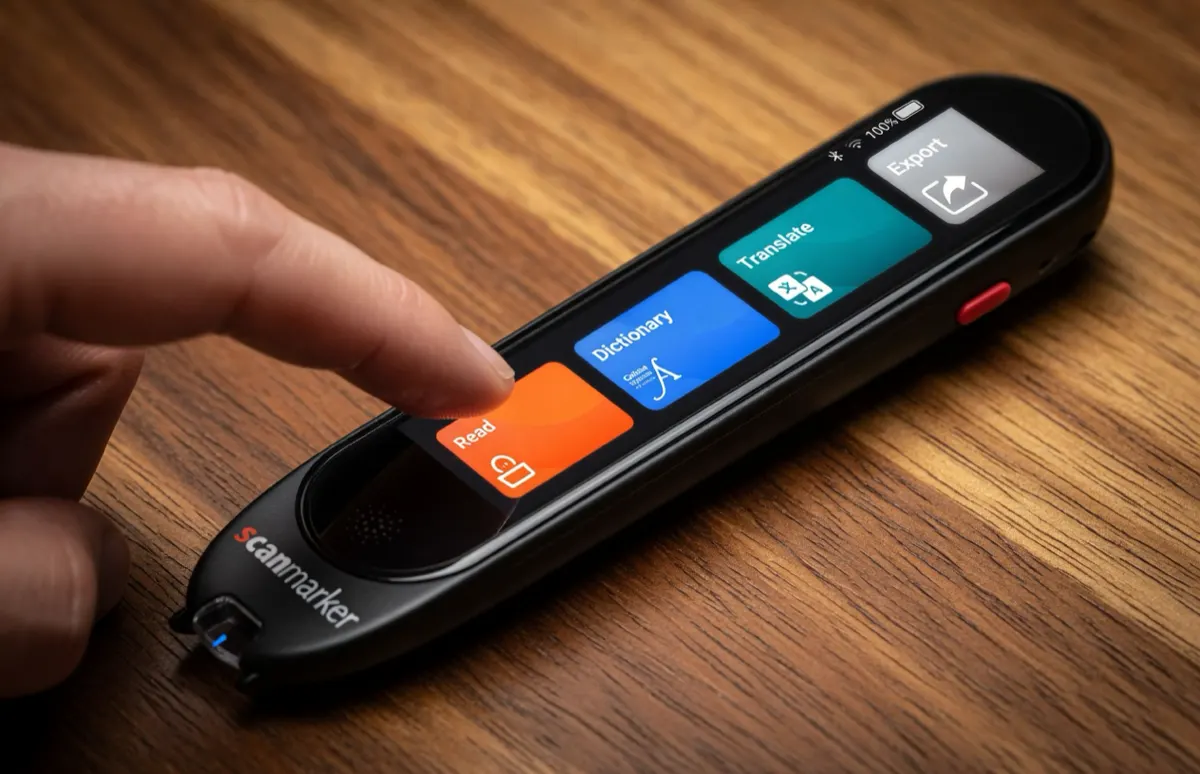
How a reader pen actually works
You glide the tip across a printed line at roughly the pace of normal reading. The device optically scans the text, converts it to digital characters, and speaks it aloud through a built-in speaker or headphones — the whole process takes under a second per line on current standalone models.
No internet connection is required for the core function. Offline language packs mean the device works exactly the same on a plane, in a rural classroom, or anywhere else Wi-Fi isn’t guaranteed.
Who actually uses a reader pen
Dyslexic readers, kids and adults, use one to remove the decoding step entirely for homework, textbooks, and personal reading. Adults with reading fatigue or low vision find that hearing a page instead of straining to read it removes eye strain over long sessions, not just reduces it. ESL and multilingual readers rely on models with on-device translation alongside read-aloud. Students studying dense material turn passive reading into active listening, useful for retention while multitasking. And plenty of people use one purely as a productivity preference — a reader pen isn’t only a disability-support tool.
What to look for in a reader pen
Standalone vs. connected: a standalone reader pen needs no phone or computer — the right choice if “no device required” matters to you, whether that’s classroom use, testing accommodations, or simply not wanting another app. A connected model pairs with a phone or laptop and typically adds features like syncing scanned text to notes apps.
Offline language count matters if you need the device to work without Wi-Fi in more than one language — this varies significantly between models. Battery life: look for real-world hours, not marketing “up to” figures, since a device that dies mid-homework defeats the purpose. And if you need exam-lock mode for testing accommodations, confirm the specific model supports a verifiably restricted mode, not just a general read-aloud function.
Reader pen vs. the alternatives
| Option | No phone needed | Works on printed pages | Setup time |
|---|---|---|---|
| Reader pen | Yes | Yes | None |
| Phone text-to-speech app | No | Requires a photo first | Low |
| Flatbed scanner + software | Yes | Yes | High |
| Human reading aloud | Yes | Yes | Requires another person |
Reader pen vs. translation pen
A reader pen focuses on reading text aloud in its original language. A translation pen adds the ability to convert that text into another language on the spot — Scanmarker Max and Max Bundle combine both functions, reading a translated line aloud fully offline in up to 30 languages.
FAQ
Does a reader pen need Wi-Fi or a phone to work?
No — standalone reader pens work entirely offline, scanning and reading text with no connection required. Some models offer optional phone syncing as an added feature, not a requirement.
Is a reader pen only for people with dyslexia?
No. Reader pens are used broadly for reading fatigue, low vision, language learning, and general reading preference — dyslexia support is one major use case among several.
How accurate is a reader pen on different fonts?
Modern reader pens handle standard printed fonts — textbooks, worksheets, most books — with high accuracy. Handwriting and highly stylized decorative fonts remain the weakest spot across all current models.
What’s the difference between a reader pen and a translation pen?
A reader pen reads text aloud in its original language; a translation pen converts that text into another language first. Scanmarker Max and Max Bundle do both, offline, in up to 30 languages.
Important: Information in this guide is provided for general purposes and is not a substitute for professional medical, vision, or accessibility advice. A reading pen is an assistive tool that provides access to printed text — it does not diagnose, treat, or correct any reading, vision, or attention-related condition. Last reviewed: August 2026.
← All 34 guides